
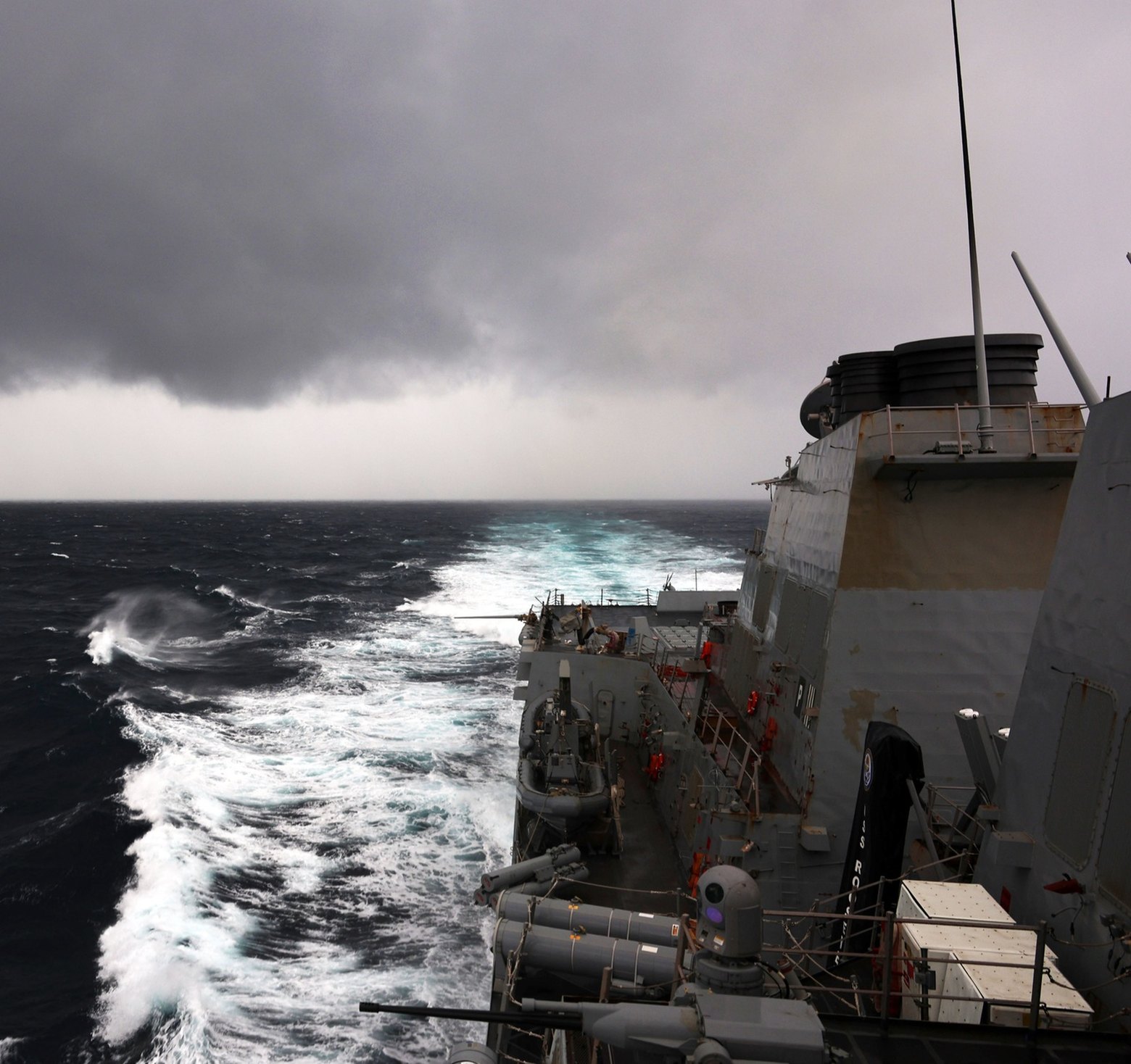
On Tuesday 1 September 2026, as London moved into evening, the United States said it was hitting Iranian military targets along the Strait of Hormuz in real time. U.S. Central Command posted that American forces were striking Islamic Revolutionary Guard Corps sites after what it called recent attempted IRGC attacks on commercial shipping in the strait and on American service members deployed in the region. President Donald Trump, writing in the present tense, said the United States was, “as we speak,” striking Iranian targets near the waterway. The Associated Press, filing the same afternoon, treated those strikes as a new target set — not a delayed write-up of Sunday’s action on Larak Island, which this newsroom has already reported as a two-launcher strike. The Independent’s live file, updating through 18:33 BST, said explosions had been heard in Bandar Abbas, on Qeshm Island, and in Jask and Sirik, all of them places that sit on Iran’s Hormuz shore. Hours earlier in Bishkek, Iranian President Masoud Pezeshkian had told the Shanghai Cooperation Organisation that Tehran would immediately reciprocate if Washington returned to the June memorandum of understanding. Pakistan’s deputy prime minister, Ishaq Dar, sitting in the same Kyrgyz capital, told his Iranian counterpart that sincere implementation of that Islamabad paper remained the only way forward.
New targets on a Tuesday, not a recap of Larak
CENTCOM’s Tuesday language described a live operation, not a press recap. The command said the strikes followed attempted IRGC attacks on merchant traffic in the Strait of Hormuz and on U.S. personnel in the theatre. It did not publish a target list, a battle-damage assessment, or a claim of Iranian casualties. AP’s Tuesday wrap was explicit on the sequencing: hostilities had gone quiet for about a month, Sunday broke that lull on Larak, and Tuesday’s action was a further set of targets inside Iran. That distinction is the brief for this package. Readers who have already seen Sunday’s island strike are not being asked to read it again. This is the new wave, and the diplomacy that ran on the same calendar day.
Sunday remains the hinge, not the copy. U.S. forces hit two launchers on Larak after, Washington said, IRGC units were preparing to put sea mines into the strait. Iran answered with ballistic missiles at American-used sites in Jordan, which U.S. and partner accounts say were intercepted. The United Arab Emirates said it stopped an Iranian drone over its waters. Trump, on Monday, had already told Fox News the United States would “hit them hard.” Tuesday was that follow-through in CENTCOM’s telling.
The maritime backdrop is also Monday. The British military’s United Kingdom Maritime Trade Operations centre reported a tanker hit by three projectiles east of Oman as it left the Gulf through the strait, and a second incident the same day involving a tanker and military forces off the Omani coast. No one had claimed those attacks when Tuesday’s American strikes were announced. They sit in the file as the commercial-shipping half of the justification CENTCOM put on the table.
Explosions named along the waterway
The Independent, compiling local media through the London evening, named four places: Bandar Abbas, Iran’s main southern port city; Qeshm, the large island in the mouth of the strait; Jask, further east along the Gulf of Oman; and Sirik, on the same Iranian shore. All four sit on the waterway the war has turned into a rationed passage. CENTCOM said the aim was IRGC targets. It did not confirm those four names, and this newsroom is not going to turn unconfirmed blast reports into a map of destroyed neighbourhoods. The honest status at 18:25–18:33 BST was narrower: Washington says it is hitting Guard sites near Hormuz; Iranian local reporting says blasts have been heard in those four locations; casualty and damage figures had not been independently established in the Western wires this package is written from.
Bandar Abbas is not an anonymous pin. It is the city that handles a large share of Iran’s remaining seaborne trade. Qeshm sits in the same choke as Larak. Jask and Sirik watch the eastern approaches, where the strait opens toward the Arabian Sea. A strike package described as “near the Strait of Hormuz” can be all of those places without being a second draft of one island.
A warning issued while the strikes were still running
Trump’s Tuesday post did two jobs at once: it claimed the operation was under way, and it told Tehran not to answer it. He called the strikes “large and powerful.” He tied them to what he said was a failed Iranian attempt to put sea mines back into a strait he insists is now clear — “completely removed or detonated” — and to eight missiles fired at a U.S. military base in Jordan, “all successfully knocked down.” If Iran hit back, he wrote, it would be struck “at a much harder and higher level.” He added that this was not “the biggest attack of them all,” that that option was “waiting in the wings,” and that when it was over there would be “very little left of the Islamic Republic of Iran.”
That is presidential messaging, not a CENTCOM targeting annex. The command’s own sentence was narrower: IRGC attempts against shipping and against American service members. The gap between those two registers is the politics of Tuesday night. One is a retaliation brief. The other is a threat to the state. Readers should keep them labelled.
Trump had spent Monday calling Iran a “failed nation” and posting an AI-generated clip that purported to show Kharg Island, the terminal that still handles the bulk of Iran’s oil exports, “being blown to smithereens.” Hamid Bovard, who runs the National Iranian Oil Company, said Kharg was calm and that operations had not stopped. A U.S. official, speaking to other outlets, said Kharg had not been in the overnight target set. Tuesday’s named geography, in the Independent’s live file, was the Hormuz shore — not Kharg. A social-media video is not a strike report.
Pezeshkian’s offer, timed before the new wave
The Iranian president was in Bishkek for the SCO heads-of-state meeting when he said the sentence that will travel with this story. Iranian state media, via IRNA and picked up by AP and Al Jazeera, quoted him: if the United States returns to its commitments under the memorandum of understanding, the Islamic Republic will immediately reciprocate. AP noted the timing. Those remarks came before the latest American strike inside Iran. They were not a response to Tuesday’s bombs. They were an offer already on the table when the bombs started.
Pezeshkian also put a clock on Washington’s last try. America’s commitment to the document signed by its president, he said, had lasted less than two weeks, after which “excessive demands” and a walk-back began and had not stopped. Foreign ministry spokesman Esmaeil Baghaei said the United States “broke its promises” under the MoU. That is Tehran’s ledger. Washington’s ledger, spoken by Treasury Secretary Scott Bessent the same day, is that the expired framework failed because Iran was not ready for a deal. Both sentences can be reported. Neither is a verdict.
The summit itself is not a sideshow. China, Russia, Central Asia, Iran, Pakistan and India use the SCO as a room where Western war policy is discussed without Washington in the chair. Pezeshkian’s line was aimed at that room as much as at the White House: Iran will move if the United States moves first. It is the opposite of Trump’s sequencing, which is pressure first and talks when Tehran is, in Bessent’s phrase, made to “want to have a deal.”
Islamabad’s paper, and the Pakistani line from Bishkek
The memorandum both men keep naming is the Islamabad MoU of June 2026 — a 14-point interim text brokered by Pakistan, with Qatar in the room, and signed around 17–18 June by Trump and Pezeshkian. It was supposed to freeze the shooting and open a 60-day window for a wider peace. Iran was to clear the Strait of Hormuz of mines and let ships through, without charge, for that period. The United States was to end its naval blockade, lift sanctions, issue waivers for Iranian oil, allow access to frozen funds, and start work on a reconstruction package that, in the published outline, ran to at least $300 billion. A “final deal,” the text said, would be put to the UN Security Council.
It did not last. Within days both capitals were accusing the other of violations. Trump called Iranian regional strikes a “foolish violation.” Iran said U.S. strikes violated Article 1. The 60-day clock ran out in mid-August without an extension. Iranian officials later argued there was no ceasefire left to renew because Washington had already broken the paper. A month of relative quiet followed. Sunday ended that quiet. Tuesday thickened it.
Pakistan’s interest is not rhetorical. Islamabad hosted the talks. It had already brokered a two-week ceasefire in April after six weeks of fighting. On Tuesday, on the SCO sidelines in Bishkek, Dar sat with Iranian foreign minister Seyyed Abbas Araghchi. The Foreign Office in Islamabad said the two men discussed bilateral ties and the region, and that Dar underlined a single operational sentence: dialogue and diplomacy remain essential, and “sincere implementation by both parties to the conflict of the Islamabad Memorandum of Understanding of June 2026 remains the only way forward.” Prime Minister Shehbaz Sharif was in Kyrgyzstan on the same trip. Dar also met China’s Wang Yi. That is the Pakistani story of this day: the broker is still in the building, repeating the paper, while the two signatories shoot.
Qatar, the other facilitator, was as blunt in Doha. Foreign ministry spokesman Majed al-Ansari said the return of escalation was in no one’s interest, and that Doha was working with partners on a peaceful track and on reopening the strait. Officials from Pakistan, Qatar and Oman had been in Tehran last week on a diplomatic push that did not prevent the weekend exchange. Oman, which sits on the southern shore of Hormuz, has been talking to Iran about a traffic-management framework. Other Gulf capitals want the strait opened without Iranian conditions. Saudi Crown Prince Mohammed bin Salman met Oman’s Sultan Haitham bin Tariq on Tuesday; the Saudi Press Agency said they discussed regional security and stability and did not, in the published readout, name Hormuz.
Bessent’s banks, pipelines, and a strait he wants to retire
While CENTCOM was shooting and Pezeshkian was bargaining, Bessent was at the G20 finance gathering in Asheville, North Carolina, talking as if the waterway itself could be written out of the energy system. “In two years, the Strait of Hormuz will be a worthless piece of water,” he said. Oil, in his forecast, would move on land pipelines. He has previously put a figure on that shift — up to about 70 per cent of the energy that used to go through Hormuz. The United Arab Emirates is expanding the west-east line that ends at Fujairah, due in 2027. Other schemes have been sketched through Saudi Arabia, Iraq, Syria and Turkey. Bessent’s political point was sharper than the engineering: Iran is trying to use Hormuz as a choke; it is not a choke for the United States; it is a choke for many other countries.
The Treasury half of Tuesday is as important as the missiles. Bessent said Washington would probably announce a bank sanction this week and another the week after, after what he called a great show of support from allies — the EU, the ECB, the UK, the UAE. Operation Economic Outcast, launched in late August, is the campaign name: weekly secondary pressure on banks, shippers and anyone still tying Tehran to the dollar system. He told The National his job was to make sure Iran wanted a deal, and that the expired June framework had not worked because Tehran was not ready. He also said he had spoken privately with China’s central-bank governor, Pan Gongsheng, and claimed overlap on two points: Iran should not have a nuclear weapon, and there should be freedom of navigation in Hormuz. China still takes the overwhelming share of whatever Iranian crude moves.
Oil had already moved before the Tuesday afternoon strikes hit the wires. Al Jazeera, using a morning print, put Brent for November at $92.31 a barrel at 08:45 GMT, up about 2 per cent on the day and following a more than 2.5 per cent rise on Monday after Larak, the Jordan missiles, and the tanker reports. That is not a closing print for Tuesday night, and this newsroom will not invent one. It is enough to say the market was already paying a Hormuz premium when CENTCOM said the new strikes were under way. Saul Kavonic of MST Financial told Al Jazeera the oil market was absorbing a “no war, no peace” horizon that could run well into 2027, with only partial volumes through the strait. MarineTraffic counted 107 transits in the week to 30 August, against 121 the week before, and against something like 130 a day before the war. Many ships now sail “dark,” AIS off.
A night that is still open
By Tuesday evening in London the two tracks were both live and pointing opposite ways. CENTCOM and the president said American forces were hitting IRGC targets near Hormuz. Iranian local media had named four shoreline places where blasts were heard. Pezeshkian’s offer — Washington first, then immediate reciprocity — was already on the record from Bishkek, spoken before those blasts. Dar had told Araghchi that the Islamabad MoU, sincerely applied by both sides, was still the only road. Bessent was promising more bank names and a future in which Hormuz did not matter. Qatar and Oman were still talking about a reopened strait. None of that had produced a ceasefire by the time this package was filed.
What happens next is a set of tests, not a prediction. Whether Tehran answers Tuesday’s strikes the way it answered Larak — Jordan, the UAE, or something closer to shipping — will decide if this is a 48-hour spike or the end of the month-long lull. Whether Washington treats Pezeshkian’s sentence as an opening or as noise will decide if the Islamabad paper has another life. Pakistan’s broker role only works if both capitals still want a document they signed in June and buried in August. The oil price will keep marking the strait even if Bessent wants to retire it. This newsroom will not recap Sunday’s two launchers as if they were today’s news. Tuesday is a new target set, a live CENTCOM operation, an SCO offer, and a Pakistani reminder that the only paper on the table still has Islamabad’s name on it.
Syed Aqeel — author and verified this story.
Comments(0
No comments yet. Be the first!