
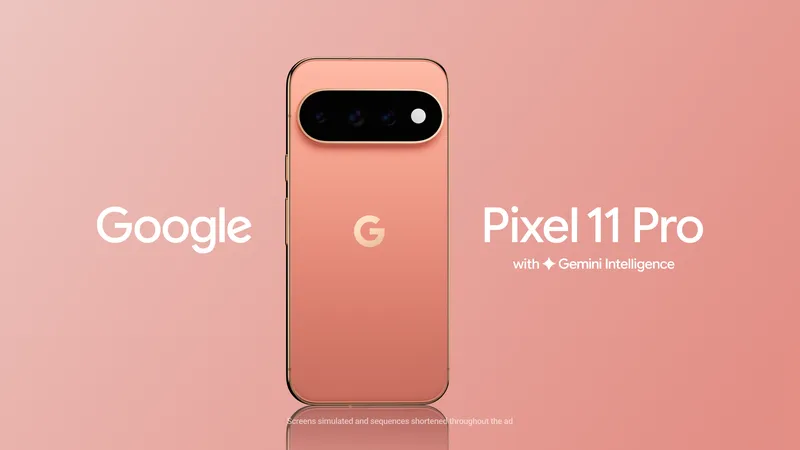
Breaking Barriers: Google Pixel 11 Introduces Real-Time Sign Language-to-Text Translation
In a significant leap forward for inclusive technology, Google has unveiled a transformative feature for its upcoming Pixel 11 lineup: the ability to convert sign language directly into written text. Developed by the pioneers at Google DeepMind, this new AI model, known as SL2T (Sign Language to Text), is designed to make digital communication more seamless for the deaf and hard-of-hearing communities.
A New Way to "Speak" to Your Smartphone Traditionally, users interact with their phones through touch or voice. However, for those whose primary language is visual, these methods can often feel restrictive. The SL2T model changes the narrative by integrating directly with widely used apps like Gboard and Live Transcribe. This allows users to perform Google searches, draft text messages, or even interact with the Gemini AI assistant simply by signing in front of the phone’s camera.
Initially, the technology will support American Sign Language (ASL), translating it into English, with Google promising that support for more languages and devices will roll out in the near future.
The Science Behind the Sign Translating sign language is significantly more complex than standard speech-to-text. Unlike spoken words, sign language is a multi-dimensional "natural language" with its own unique grammar and syntax. It isn't just about hand movements; it involves the position of the arms, body posture, and—crucially—facial expressions.
To tackle this, Google’s SL2T doesn't just look for individual hand shapes. Instead, it uses a system called MediaPipe Holistic to track geometric "landmarks" on the user's body. By converting these movements into mathematical coordinates on-device, the system can interpret the context and flow of the language without needing to store or send raw video footage to the cloud, ensuring high levels of user privacy.
Proven Performance and Training The robustness of SL2T comes from an intensive training regimen. Google DeepMind trained the model on over 100,000 hours of sign language data spanning more than 50 different global sign languages. This diverse dataset helped the AI learn common patterns across different dialects, leading to impressive results. In specialized benchmarks like the FLEURS-ASL test, the model achieved a high score of 70 on the BLEURT metric, significantly outperforming previous industry standards.
Real-World Application and Accessibility For a user in a live conversation, this means they can use sign language to respond in real-time through the Live Transcribe app. Early testers found that signing was often faster and felt more natural than typing on a small keyboard. While Google acknowledges that challenges remain—such as interpreting rare signs or very fast finger-spelling—the Pixel 11 represents the first major commercial step toward a world where the smartphone acts as a universal, real-time translator between visual and written worlds.
Source : Al jazeera
Comments(0
No comments yet. Be the first!