
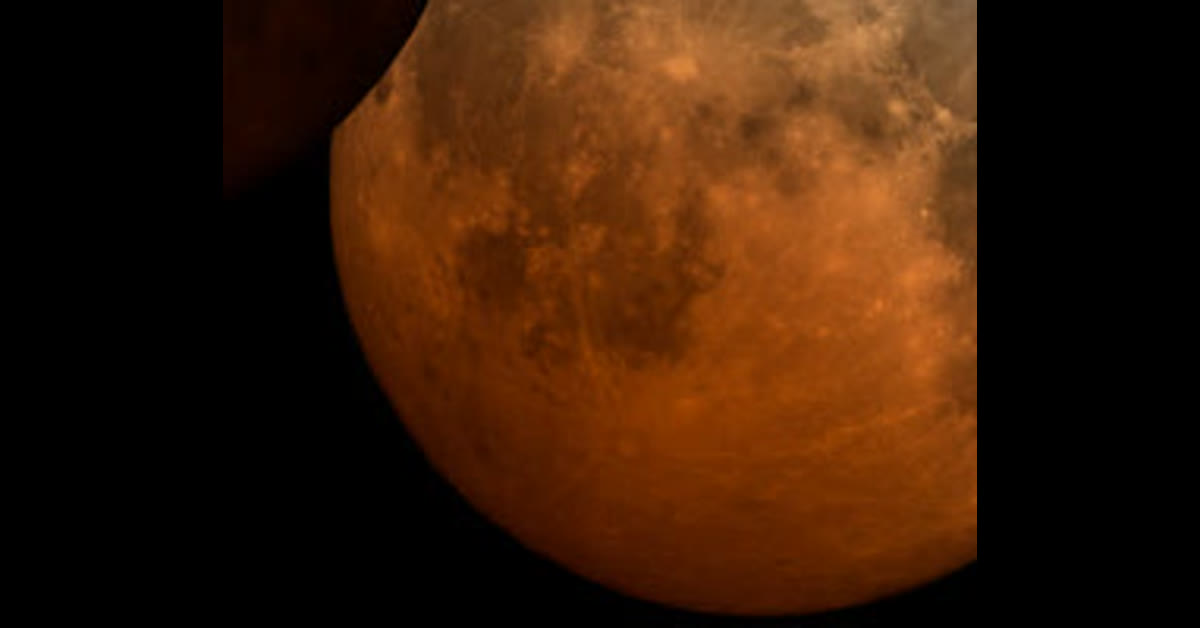
By Friday afternoon in London, the Moon was long down and the search bar had not caught up. The cleanest, hottest Google Trends query in the United States over the past four hours was “blood moon total lunar eclipse tonight” — more than 5,000 searches, up about 1,000 percent, still marked Active, on a four-hour chart that has been rising since morning. That string describes a total lunar eclipse. The sky that actually moved through Earth’s shadow on the night of 27–28 August 2026 did not. NASA’s Scientific Visualization Studio put 96.3 percent of the lunar disk inside the umbra at greatest eclipse, 4:13 UTC on Friday — 12:13 a.m. Eastern Daylight Time, 11:13 p.m. Central on Thursday. What people saw, where the weather allowed, was a copper-red Moon with a bright silver sliver still lit on the northern limb. Last eclipse of 2026. Not a true total blood moon.
The mismatch is the story. Search language borrowed the drama of totality. The geometry stopped one step short.
Searchers named a total. The umbra left a rim
A blood moon, in the sense astronomers will defend, is a total lunar eclipse. The whole Moon sits in the umbra, the core of Earth’s shadow, where the Sun is blocked outright. The disk does not go black. Sunlight skims through hundreds of kilometres of air around the planet’s limb, loses most of its blue, and paints the Moon copper, rust, even brick. That is the colour people mean when they say blood.
Thursday night into Friday never crossed that line. The alignment of Sun, Earth and Moon was close, not perfect. A sliver of the north limb stayed in sunlight — a silver thread on a copper coin. Associated Press, filing from Cape Canaveral, was blunt: observers across the Americas were in the prime longitude, and it still was not a true blood moon, because the eclipse never went total. USA Today’s useful shorthand, “almost blood moon,” is the honest caption. Google’s query is the dishonest one.
The obscuration figure is the one to keep. NASA’s Ernie Wright, in SVS visualization 5672, is careful about the vocabulary. Umbra magnitude, the number on classic NASA eclipse maps, is the fraction of the Moon’s diameter covered by the shadow. Obscuration is the fraction of the area. The 96.3 percent that travelled with this eclipse is area. Fred Espenak’s NASA Goddard sheet lists an umbral magnitude near 0.93 — roughly 93 percent of the Moon’s width. Both describe the same near-miss. Neither is totality.
Copper disk, silver thread
At mid-eclipse the shadowed face did what deep partials do when the leftover sunlit cap is small enough for the eye to stop being dazzled. The umbra stopped looking like a grey bite and started looking like metal left in a fire. Wright’s studio sequence, timed in Universal Time, leaves copies of the Moon along the path: a dimmed full disk in the penumbra, a half-and-half at 50 percent, then the 4:13 UTC standout — almost the entire globe in copper and orange, with that northern sliver still grey-white and crater-sharp. EarthSky’s observers have noted the same geometry on other deep partials: a bright patch on the limb that never entered the umbra, which is simply the part of the Moon still in daylight.
That sliver is why photographs from the Americas will not match a March 2026 totality. In March the Moon went fully into the shadow and the silver went away. This week the silver stayed. Sky & Telescope had flagged a pale band that can sit between the bright rim and the reddened disk, a trick of ozone absorbing red light in the stratosphere. Whether a given backyard saw that turquoise edge depended on haze, wildfire smoke and how dark the local sky was. The copper, once the glare dropped, was the reliable feature.
August’s full Moon also carries a folk name, the Sturgeon Moon, from Great Lakes and other North American traditions tied to the fish season. The name is a calendar label, not a forecast. The eclipse did not care what the almanac called the disk. It only cared that the Moon was full and that Earth’s shadow was in the way.
The long night sat over the Americas
Lunar eclipses are not path events in the way solar eclipses are. Anyone on the night side of Earth can see the same Moon at the same Universal Time, clocks aside. The catch is horizon. AP counted nearly a billion people in the United States, Canada, and Central and South America who could watch every stage, and more than three billion people — about 44 percent of the planet — who could catch at least some of it. NASA’s visibility map, centred near 63 degrees west, the sublunar point at greatest eclipse, put the deep umbral show over the Americas except Alaska and northwestern Canada, plus western Europe and western Africa.
USA Today, quoting NASA, split the United States the same way: the East Coast and much of the Midwest could sit through the whole eclipse; Alaska and the West Coast caught it in progress, with the Moon still climbing. Hawaii and the eastern Pacific got a late start as the Moon rose. South America, AP and USA Today both noted, had the full run.
The timetable, rounded to the figures NASA and Sky & Telescope published, ran like this. The Moon first nosed into the penumbra, the pale outer shadow, near 01:24 UTC on 28 August — 9:24 p.m. Eastern, 8:24 p.m. Central on the 27th. Most eyes miss that stage. The umbra took its first dark bite near 02:34 UTC, 10:34 p.m. Eastern. Greatest eclipse at 4:13 UTC. The umbral phase ended near 05:52 UTC. The last penumbral shading faded near 07:02 UTC. AP called the partial stage more than three hours and the whole event about five and a half. Time and Date’s global sheet is in the same band: roughly 3 hours 18 minutes umbral, 5 hours 38 minutes from first penumbra to last.
Pacific, mountain and Alaska clocks simply slide that table backward. Greatest eclipse was 10:13 p.m. MDT and 9:13 p.m. PDT on Thursday, still evening for people who did not have to set an alarm. On the US East Coast it was Friday by a quarter hour. That is why the search query kept the word “tonight” into Friday morning. For a large share of the country, the peak had been Thursday night.
Britain got the dawn, then moonset
Europe, Africa and the Middle East watched the eclipsed Moon sink. That is the other half of AP’s geography: a truncated show, cut by the horizon rather than by the shadow. BBC Weather, in a piece by Sophia Herod and Ben Rich updated on 27 August, laid out the United Kingdom’s night in British Summer Time. The penumbra began around 02:23 BST. The umbra arrived at 03:33. Maximum came at 05:12, with about 93 percent of the Moon in the darkest shadow — a local figure, not NASA’s global 96.3 percent, and a reminder that a low Moon and a published obscuration are not the same photograph. The partial phase, on the ephemeris, ended at 06:51 BST. By then the Moon had already set.
Moonset times, the BBC noted, were not uniform: about 06:00 in Lerwick, 06:15 in London, 06:42 in Enniskillen. The disk was very low in the south-west, which is where the Moon illusion does its work — the brain reading a horizon Moon as larger than the same disk overhead. That is psychology, not optics, and it can make a copper Moon against a terrace or a tree line look theatrical even when cloud is winning.
Cloud did win in places. A slack low sat over the UK, showers in the mix, breaks hard to pin. BBC’s best odds were eastern and south-eastern England, with a chance of clear spells in western Scotland and Northern Ireland. Anyone who did get a hole in the cloud was looking at a dawn object, not a midnight one. For London on Friday afternoon, the event is already a recap.
Red is filtered sunlight, not a portent
The colour is physics that has been explained every eclipse season and still gets overwritten by the word blood. Earth is a disk with an atmosphere. When the Moon is in the umbra, direct sunlight is gone. Light that still reaches it has travelled through that atmosphere. Short blue wavelengths scatter. Longer red and orange wavelengths are more likely to continue, then bounce off lunar dust and rock back toward anyone on the night side. BBC Weather walked through that chain for UK readers; NASA’s public eclipse pages say the same thing in drier language. The Moon is not on fire. It is wearing every sunrise on Earth at once.
A partial eclipse complicates the picture because one rim is still in raw sunlight. That is the silver. Until that rim shrinks, the eye — and the phone camera — expose for the bright part and crush the red. Wright’s visualizations deliberately lift the exposure toward mid-eclipse to mimic dark adaptation. Backyard observers who waited, and who looked away from porch lights, saw more copper than people who glanced up at 10:40 p.m. Eastern and went back inside.
University of Miami astrophysicist Nico Cappelluti, speaking to USA Today before the night, reduced the viewing kit to almost nothing: no special filter, no telescope required, a phone zoom enough for a souvenir. Lunar eclipses are safe for unaided eyes. That is the opposite of the 12 August solar eclipse, when looking at the Sun without proper solar filters was a way to burn a retina. The public-safety line for this week was simpler and easy to ignore in the noise: you may look.
You did not need a dark-sky park, either. Cappelluti’s practical list — check cloud, give your eyes a few minutes, keep the Moon itself clear of a roof line — is the whole method. Light pollution washes out the Milky Way. It does not erase a full Moon, even a dimmed one.
The fourth eclipse, then a gap
Eclipses travel in packs because the Sun, Moon and Earth line up in seasons, not as isolated tricks. AP’s Marcia Dunn framed the night as the lunar follow-up, two weeks after the total solar eclipse that crossed Greenland, Iceland and Spain. She also restated the size-and-distance coincidence: the Moon is about 400 times smaller than the Sun and about 400 times closer, so the two disks match in the sky. That overlap is why a solar eclipse can go total. A lunar eclipse is slower and easier to share, because Earth’s shadow is the large object doing the covering.
NASA and USA Today both counted four eclipses in 2026: an annular solar eclipse on 17 February, a total lunar eclipse on 3 March over the Americas, Australia and eastern Asia, the 12 August total solar eclipse, and this deep partial. That is the set. There is not a fifth. The next complete lunar blackout, AP reported, is New Year’s Eve 2028, with Asia and Australia at centre stage. North and South America wait until 2029 for another total eclipse of the Moon.
This week’s event belongs to Saros 138. SVS notes an 18-year, 11-day, 8-hour beat; the previous cousin was 16 August 2008, the next 7 September 2044. Those dates are for people who collect eclipse families. For everyone else the useful calendar is shorter. If you wanted a true blood moon from a US or Brazilian backyard, this was not the night, and the next one is not in 2026.
ISS commander Jessica Meir, speaking to AP, called space a unique place to watch eclipses and auroras. Jack Hathaway, also on station, had been talking up the year’s lunar work after Artemis II’s April flyby. Those are colour around the same geometry, not a change in it. The Moon did not need a spacecraft to be 96 percent in shadow. It needed a clear line of sight and a willingness to accept a sliver of leftover day.
What the spike still gets wrong
A Trends chart does not rewrite an ephemeris. The query that led US search this afternoon asked for totality, tonight, and blood. Two of those words failed. Totality never arrived. “Tonight” is already a timezone argument: correct for Thursday evening in much of North America, stale for Friday afternoon in London, and never correct as a description of a total eclipse. Blood, as AP used it, is a term of art that this eclipse did not earn.
What the night did earn is easier to defend. A deep partial of 96.3 percent is rare enough to look, to almost everyone who stepped outside, like the posters. The copper was real. The northern silver was real. The Sturgeon Moon was the ordinary full Moon underneath. The last eclipse of 2026 is now in the log. The correction is small and worth making while the search spike is still live: it was not a total blood moon. It was an almost, and the almost was the point.
Syed Aqeel (Founder, CEO, and Developer) — wrote / author this story. Syed Aqeel (Founder, CEO, and Developer) — verified this story.
Comments(0
No comments yet. Be the first!